

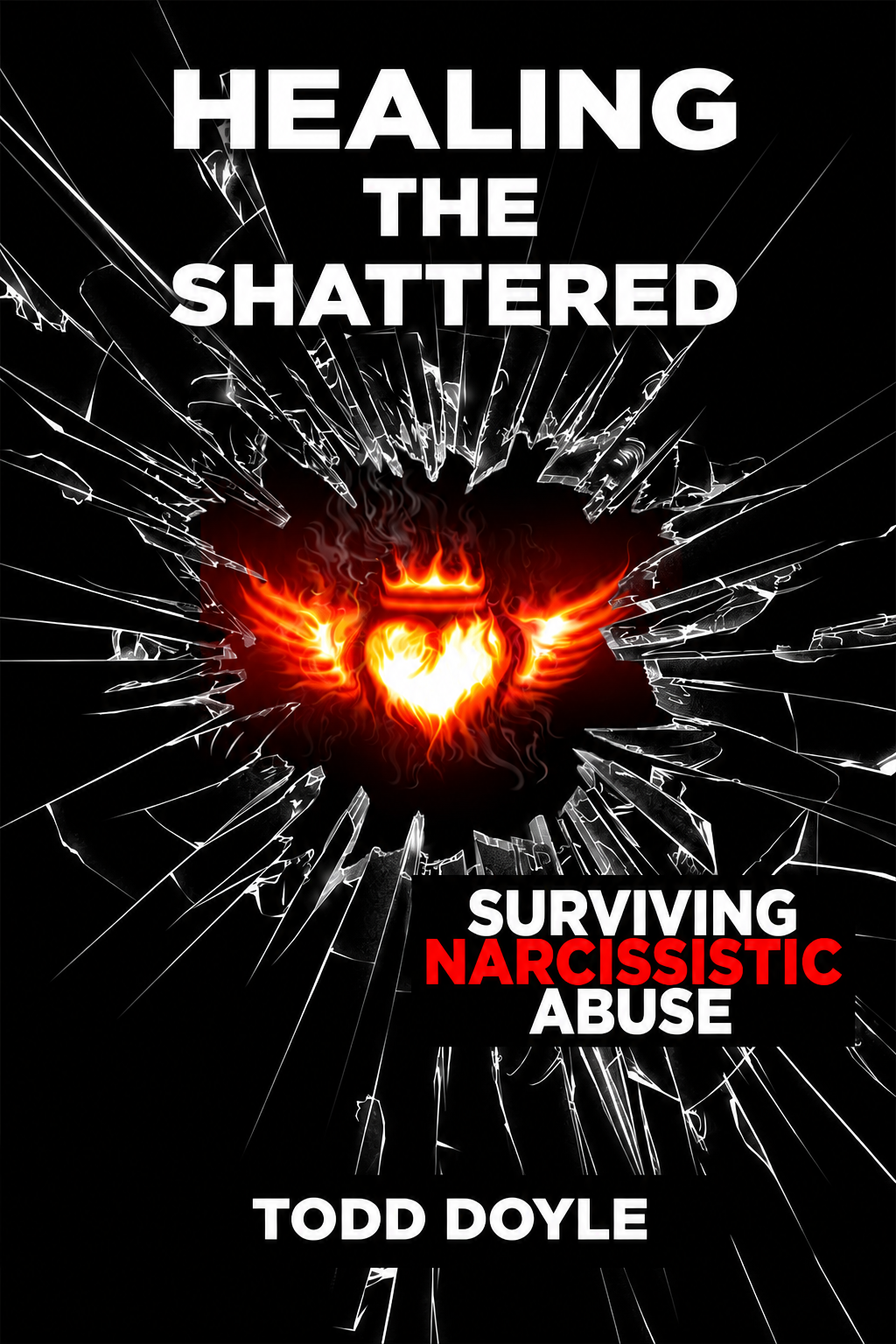
The title of my book isn’t a metaphor I picked for effect. “Healing the Shattered” describes something specific I lived through: the experience of feeling like a whole person had been broken into pieces that no longer fit together the way they used to, and the slow, uneven work of putting something workable back together.
What “shattered” was not
I want to be precise about what I mean, because the word can sound more dramatic than I intend. I don’t mean permanently destroyed, and I don’t mean broken beyond repair. Glass that shatters doesn’t disappear – the pieces are still there, still real, still made of the same material they always were. That distinction mattered to me while choosing the title. I wasn’t trying to describe something ruined. I was trying to describe something that had been forced apart and needed to be carefully put back together, not thrown away.
I also don’t mean “broken” in the sense of something inherently defective. A person who has been through narcissistic abuse isn’t damaged goods. What shatters, in my experience, is closer to a felt sense of coherence – the feeling that your perceptions, your memory, your sense of what’s reasonable, and your sense of your own worth all line up and can be trusted together. That coherence is what gets fractured. The person underneath it is still there.
What actually felt shattered
If I try to name it more specifically: it was the ability to trust my own read of a situation without a second-guessing voice immediately contradicting it. It was the sense that my needs and someone else’s needs could both matter in the same conversation. It was a basic confidence that if I explained myself clearly, I’d be understood – something I wrote about in a separate piece, because losing that particular piece of coherence was one of the most disorienting parts of the whole experience.
Each of those pieces, on its own, might not sound catastrophic. But losing several of them at once, over an extended period, while still being expected to function normally in daily life, is what “shattered” was trying to capture. Not one dramatic break. A gradual fracturing across several areas that eventually added up to something that felt whole and intact before, and didn’t anymore.
Why “healing” and not “fixing” or “repairing”
I chose “healing” deliberately too, instead of a word like “fixing” or “repairing.” Fixing implies restoring something to its exact original state, as if the goal were to pretend the damage never happened. That was never realistic, and I don’t think it’s even a useful goal. Healing, to me, means something closer to: the pieces are real, they’re yours, and you can learn to hold them together in a way that actually works for the life you’re living now – not necessarily identical to how things were arranged before.
That’s a meaningful difference in practice. If the standard is “get back to exactly who I was before,” almost everyone will feel like they’re failing, because that specific version of a person, untouched by what happened, doesn’t exist to return to. If the standard is “build something workable and genuinely yours out of the pieces you actually have,” that’s something achievable, even if it looks different from what came before.
A scene that shaped the title
I remember sitting with a stack of notes early in writing this book, trying to describe what the recovery process actually felt like day to day, and realizing that “healing” alone didn’t capture the starting condition. It made recovery sound smooth and linear, like a wound closing cleanly. It wasn’t like that. It was closer to gathering up pieces that didn’t obviously belong together anymore and figuring out, slowly, which ones still fit and which ones needed to be set down differently. “Shattered” was the word that matched that starting point honestly, without softening it into something tidier than it actually was.
I also didn’t want a title that implied a single dramatic moment of breaking. For a lot of survivors, including me, the fracturing happens gradually, through repetition, not through one identifiable event. “Shattered” can describe that slower kind of breaking too – plenty of things shatter not from one blow, but from accumulated stress finally reaching a breaking point.
What I hope the title signals to a reader
If you picked up the book because the title resonated, here’s what I hope it signals honestly: this isn’t a story about being permanently broken, and it isn’t a story about a quick fix either. It’s an attempt to describe, as clearly as I could, what it actually felt like to lose that sense of coherence, and what it took – unevenly, imperfectly, over real time – to build something workable again.
If “shattered” is a word that matches something you’re currently experiencing, I hope that recognition itself is useful, even before anything else in the book is. Naming the specific shape of what’s missing is often the first real step toward addressing it, more than any dramatic before-and-after could be.
One more piece I didn’t expect to find in the title
Something I didn’t fully anticipate when choosing this title is how many readers would tell me the word “shattered” helped them stop minimizing their own experience. A few people described downplaying what they’d been through for years – telling themselves it “wasn’t that bad,” or that other people had it worse, or that they should already be over it. Having a word that matched the actual scale of what they felt, without exaggerating it, gave some of them permission to take their own experience seriously for the first time.
I think that’s worth naming directly: minimizing your own experience doesn’t make healing easier. It usually just delays the point where you start addressing what’s actually there. If “shattered” is an accurate word for what happened to you, using it honestly – with yourself, if nowhere else yet – may be more useful than reaching for a smaller, more comfortable word that doesn’t quite fit.
That’s what the title has come to mean to me now, a while after choosing it: not a label for being broken forever, and not a dramatic flourish, but the most honest word I had for a real, specific experience – and an invitation to take the healing part just as seriously as the shattering part.


 Buy Paperback on Amazon
 Buy Signed Copy • PayPal